
8 FAQs for Ultrasonic Atomization Ultrasonic Nozzle
Ultrasonic Atomization Nozzle FAQs | Working Principle, Size & Applications
Q1: What is an ultrasonic atomization nozzle and how does it work?
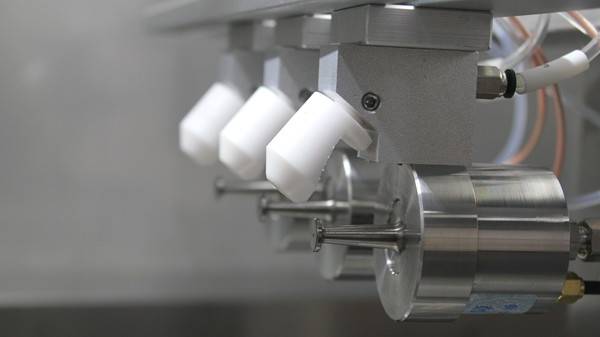
An ultrasonic atomization nozzle is a precision spray device that utilizes high-frequency ultrasonic vibration to convert liquid into uniform fine mist. Unlike traditional pressure nozzles that force liquid through tiny orifices, it generates high-frequency capillary waves on the nozzle’s vibrating surface; when the wave amplitude reaches a critical value, the liquid breaks apart into micron-level droplets for low-velocity, soft atomization. It requires no compressed air for core atomization, featuring low energy consumption and stable spraying performance.
Q2: What determines the droplet size of ultrasonic nozzle atomization?
The primary determinant is the nozzle’s resonant ultrasonic frequency. Higher frequencies produce smaller droplets, while lower frequencies generate larger ones. For typical industrial models, a 120 kHz nozzle produces approximately 18 μm water droplets, while 50 kHz nozzles form larger droplets. Secondary influencing factors include liquid viscosity, surface tension, flow rate, nozzle-to-substrate distance, and ambient humidity, which jointly fine-tune the final droplet uniformity.
Q3: What are the core advantages of ultrasonic atomization nozzles over conventional spray nozzles?
First, it delivers ultra-uniform droplet distribution with minimal size deviation, enabling precise thin-film coating from 20 nm to tens of microns. Second, the non-clogging design eliminates tiny precision orifices, adapting to viscous, particle-containing and easily precipitated liquids. Third, low-velocity soft spray drastically reduces overspray, material waste and substrate splashing damage. Additionally, it operates without compressed air, ensuring low noise, clean operation and lower power consumption (1–8 watts per nozzle).
Q4: What types of liquids can ultrasonic atomization nozzles handle?
They are compatible with most low-to-medium viscosity liquids, including aqueous solutions, solvents, chemical coatings, precursor solutions, cosmetic liquids and pharmaceutical reagents. The nozzle’s stainless steel or ceramic corrosion-resistant structure supports most non-strong corrosive fluids. However, liquids with extremely high viscosity, large solid particle agglomerates or strong corrosiveness are not recommended, as they may affect atomization stability or damage the nozzle vibrating surface.
Q5: What are the main application scenarios of ultrasonic atomization nozzles?
They are widely used in precision industries requiring uniform thin-layer spraying. Typical scenarios include functional coating for semiconductors and wafers, nano-material spraying, biomedical reagent atomization, cosmetic fine mist spraying, industrial humidification, gas disinfection, and surface coating of complex-shaped workpieces. They are highly adaptable for bench laboratory use and automated assembly line integration.
Q6: Why does ultrasonic nozzle produce uneven atomization or splashing, and how to fix it?
Common causes include insufficient ultrasonic vibration energy, excessive liquid flow rate, inappropriate nozzle-substrate distance, uneven liquid dispersion, or abnormal ambient humidity. Corresponding solutions: adjust the ultrasonic power to match the liquid property, reduce the liquid supply flow rate, optimize the spraying distance, fully disperse the liquid precursor to avoid agglomeration, and stabilize the working environment humidity to eliminate electrostatic adsorption interference.
Q7: Are ultrasonic atomization nozzles easy to maintain and clean?
Yes, they feature extremely low maintenance costs. The non-clogging structure avoids frequent blockage failures compared with traditional nozzles. Daily maintenance only requires regular flushing of the liquid channel with clean solvent or pure water to remove residual liquid and particle deposits. No wearing parts need frequent replacement. Regular calibration of resonant frequency can maintain long-term stable atomization performance, with a standard service life of more than one year under normal working conditions.
Q8: Can ultrasonic atomization nozzles support continuous long-term operation?
Absolutely. Professional industrial ultrasonic nozzles support both intermittent and 24-hour continuous stable operation. Adopting high-stability resonant vibration technology, they avoid frequency drift and vibration attenuation during long-term operation. Equipped with over-power and over-temperature protection designs, they can adapt to long-cycle automated production lines. Only regular daily cleaning and periodic performance inspection are needed to ensure consistent atomization quality for mass production.
About Cheersonic
Cheersonic is the leading developer and manufacturer of ultrasonic coating systems for applying precise, thin film coatings to protect, strengthen or smooth surfaces on parts and components for the microelectronics/electronics, alternative energy, medical and industrial markets, including specialized glass applications in construction and automotive.
Our coating solutions are environmentally-friendly, efficient and highly reliable, and enable dramatic reductions in overspray, savings in raw material, water and energy usage and provide improved process repeatability, transfer efficiency, high uniformity and reduced emissions.
If you have any technical questions, customization demands, or procurement inquiries about ultrasonic atomization nozzles, feel free to contact our professional sales and technical team for detailed parameters, customized solutions, and industry application support.
Email: market2@cheersonic.com
